
Every Australia Day I have the privilege of going to a country town to speak and to share in recognising volunteers and community champions who make things happen.
This year my council district is CLEVE on the Eyre Peninsula.
I've always known it was there. I had heard of its huge annual Agricultural show. I love its name. But I have never even been through Cleve.
Now, not only do I know where Cleve is and what it does, I love it.
Tuesday 24th January 2023
We always make a wee road trip of my Australia Day destinations, exploring the Council area generally as best we can - the old spouse, B and I.

So it comes to pass that we pack the car with comforts and fixings, including Patty, our travelling chilli plant, leave the beloved cat in care at Encounter Bay and drive north in the spirit of adventure.
“A steak in Wake” is a traveller’s cliche for the common pause at Port Wakefield for petrol, food, loos and coffee. The Liberty Truckstop is new, large and pristine with a huge menu, impeccable loos and friendly staff. I love rissoles and
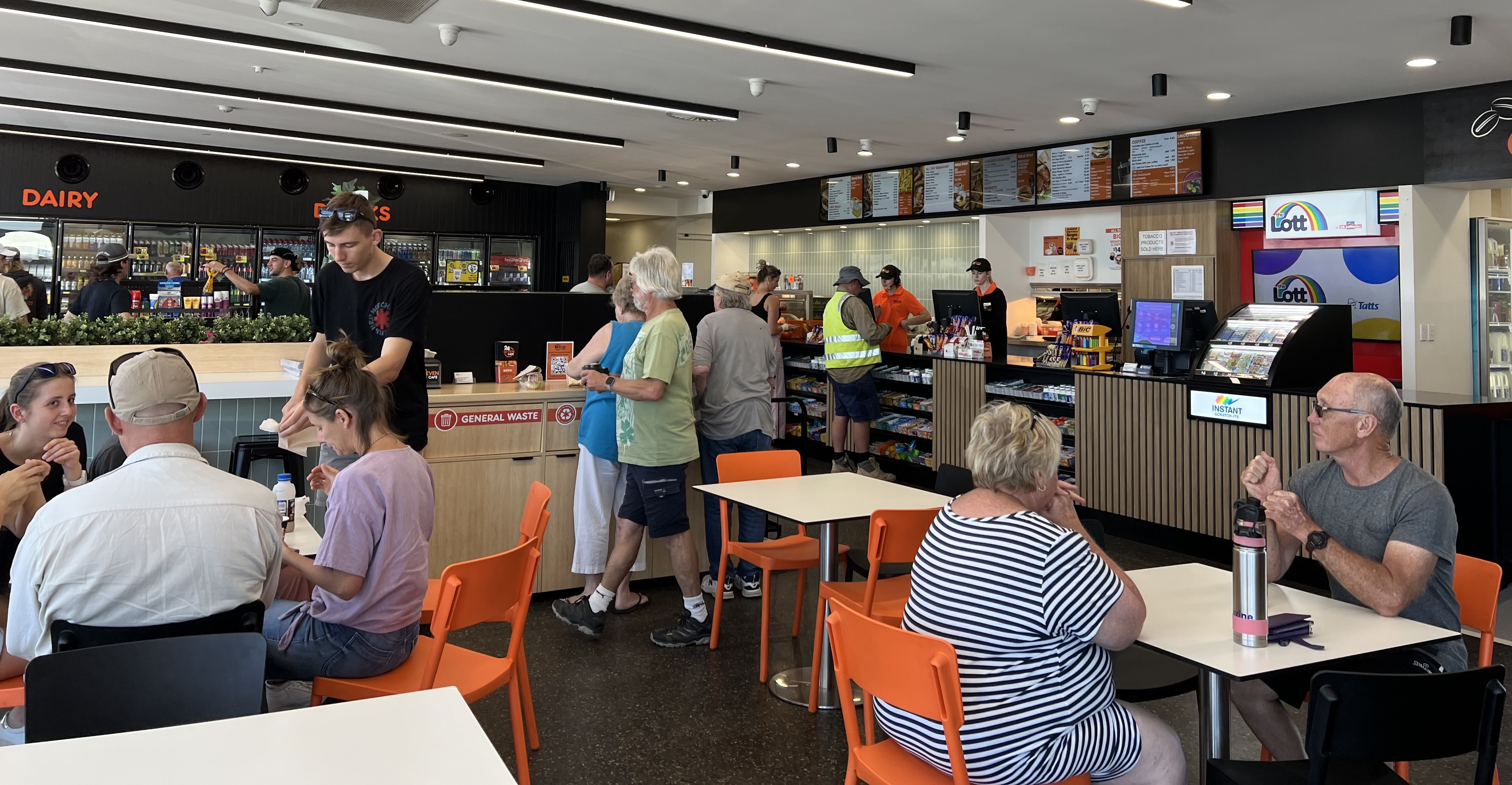
never see them on a menu so… They are generous, well sizzled and delicious, served with salad. A great start.
In all the years of travelling that highway to Port Augusta, like many, I’ve admired the pink salt lake at Locheil 130 klicks north of Adelaide, but never stopped there. This time we do.

It is a warm day and there are a few bush flies around. Bruce plucks a whisk and we take the path to the lake, pausing to read the sign which reveals that the lake’s proper name in Bumbunga. According to Normal Tindale, the anthropologist, its name comes from the Kaurna language’s “parnpangka”, meaning “rain water lake”.
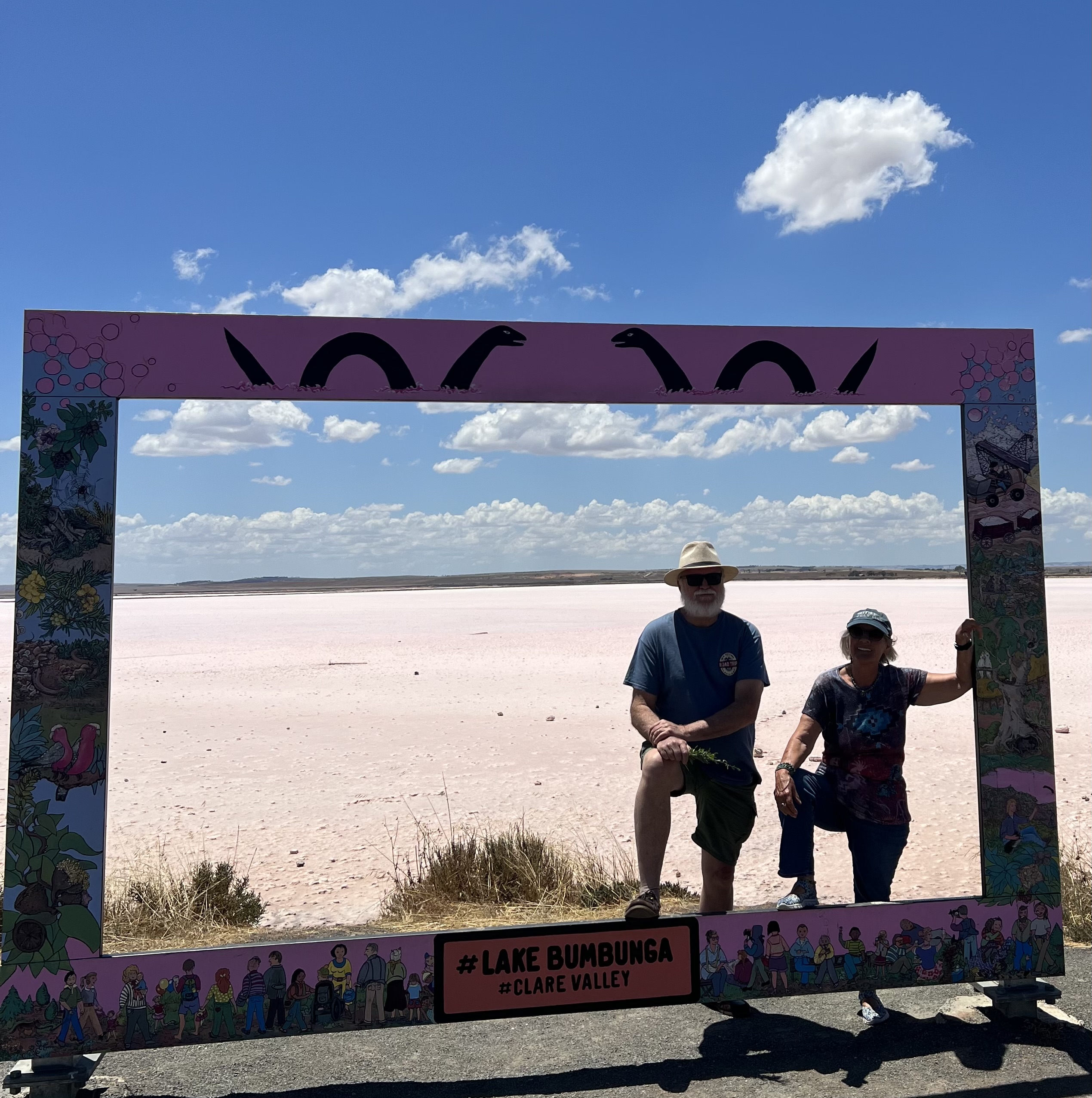

One stands out there in a blazing world of salt glare. The experience is a little like White Sands in the American New Mexico insofar as one surrenders to the bright almost-whiteness of it all. It is not a small lake. It is really rather splendid. Why didn’t we do this years ago?
The highway is undergoing a lot of roadworks. Speed restrictions are incessant and annoying, albeit the end result of improved road is invaluable - and overdue. There’s a lot of heavy transport on the road, too.
I love Port Germein and its incredibly long jetty so we swing in there for a sentimental look-see.
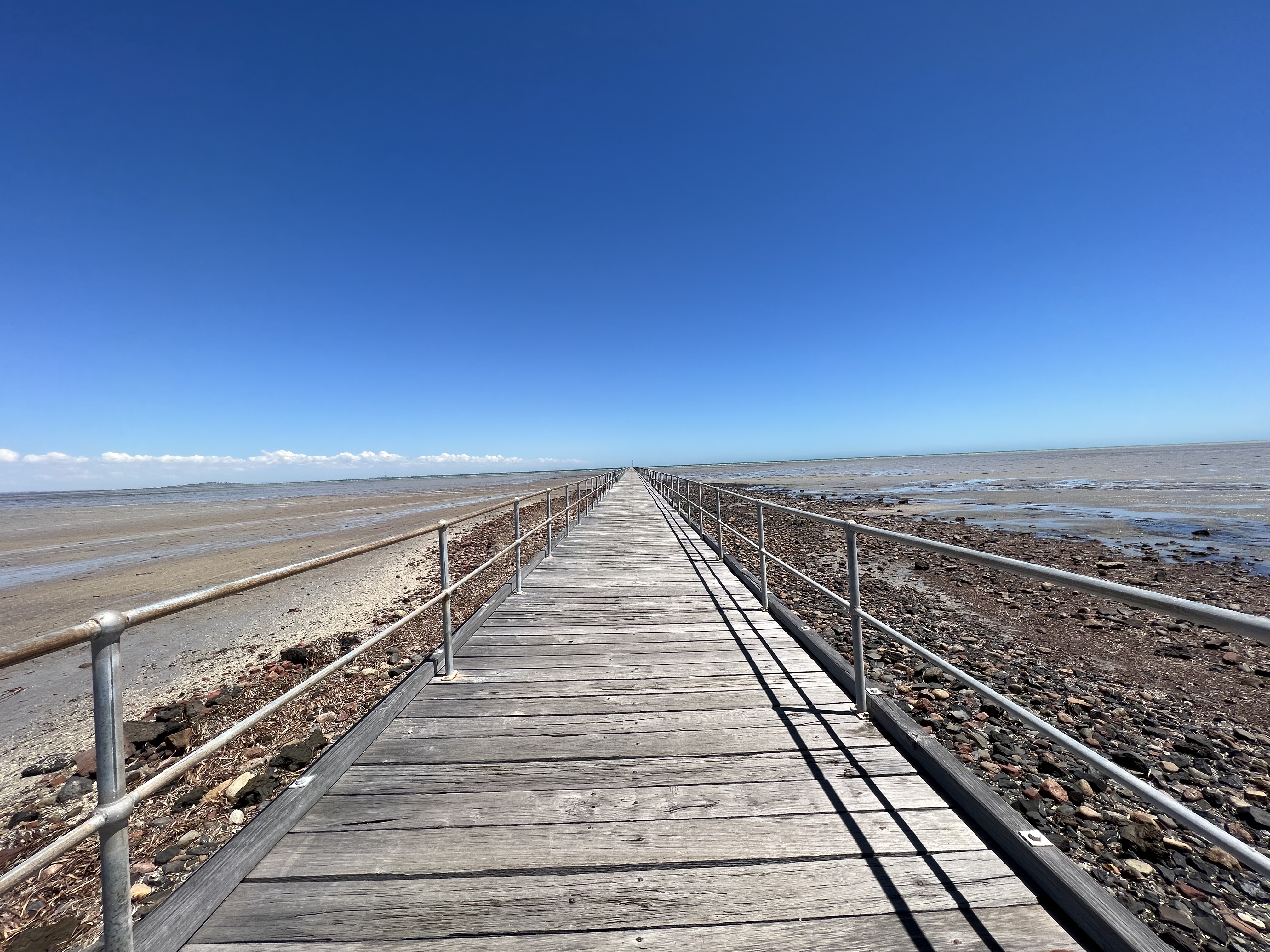
Oh, my, it is quiet. A couple of people are on the porch at the pub. But otherwise, nothing moves in the streets. It is like a ghost town. The tide is out and the bright blue sea and its white line of breakers is far, far, far away on the horizon.

B settles on a cool bench in the shade of a tree and I walk out to renew my respect for that fantastic jetty. It is a thing of wonder. I take pix and admire an array of marvellous metal sculptures - and the huge sculpted bullock head on the pier shed. Bullock drays played a big role in early farming and transport and hauling vessels in over the tidal lines. These days they use tractors, of course.
We arrive in Port Augusta in plenty of time for a swim in the Standpipe Motel’s lovely pool and a G&T before we meet our friend RoseAnne McInnes for an entirely glorious curry feast in the dining room. That Sihk-owned motel is famous for its classy curries.
Wednesday 25th.
There’s a lovely sunrise outside. We have coffee and breakfast in our room and, after I’ve stolen a morning swim, we head south towards our destination, Cleve.
We choose the oyster-farming and fishing town Cowell for lunch.

We’ve spent time in Cowell before but B points out that I’d never seen its National Trust Museum. Not like me to miss a country museum. I adore them. The fish and chips shack on the dock does not do salads so we opt for the pub, which also barely does salads but has garfish as a special. It also features languid country people drinking beer, workmen pausing en route to Port Lincoln also calling in for beer (um, ?) and a massive roll of pork slowly turning on a BBQ spit for an impending “spit and chips” special dinner.
"You should stay for it," invites the friendly old codger guarding the spit.
Ah, it looks good but it's in the wrong town today - and I have a date for dinner with the Cleve Council.

Of course, she can't resist the lure of a country the museum. It's calling her from right across the road - and, as expected, it is a veritable treasure trove.
Of course. I am its only $5 visitor. Then again, things are quiet in Cowell. I cruise from room to room through this old house, very careful not to knock anything. Cluttered is an understatement. This museum is a repository for family photos and nicknacks, kitchen equipment, dining finery and you

name it from old local families. I adore such rural town collections. Their cultural significance is never heralded. Country people are the "keepers" of domestic history because they have the storage space and the affection for a pioneer past. The elderly curator is sitting in a rocker on the porch as I leave, pretty much in a world of his own. Yes, it's a quiet day in Cowell today.
We grab milk and a few groceries from the fairly

decent little IGA and return to the road - the long, long straight undulating road across that extraordinary landscape. Its deceptively dangerous and a recently rolled vehicle with a scatter of possessions on the verge is an unnerving reminder of this.
We’ve driven this road before but this time, we take a branch which heads inland which takes us through a spectacular break in some hills and towards Cleve, which is a heartland town renowned for wheat and barley.

Presently, wheat-lands unfold, large neat acreages. It looks like prosperous, well-farmed land. And here comes the township of Cleve.
Just as the crops are broad

With its lean grid plan layout, it couldn’t be simpler to navigate. We easily find our accommodation, very new and pristine units in a set of four right opposite the Town Council offices. We are in Unit 4 and we have been told the code to release its key from its secure little box by the door. This unit is as spacious as the town - long and very white, sparsely decorated, very efficient and modern.There's a queen bed in the master bedroom and a second bedroom of bunkbeds. And a massive “access” bathroom which is huge in every aspect except for toiletries space.
We put Patty our travelling chili plant beside the front door, our symbol denoting that we have "nested" and are settled in.

I’ve been corresponding with one Kelly Morrow for weeks now. She has been my contact and liaison with the Cleve Council and she has been just such a stunning “pen pal”, so attuned with the things I ask, thinking about things, doing research,
coming back with juicy good answers which, thankyou Kelly, seriously helped this visiting Ambassador get the local crowd onside with her speech.
Anyway, Kelly works part time and had told me to go over to the council on arrival and meet her colleague Milly who had done

lovely itineraries for our visit. So, off I go, all the way across that broad, deserted country town street to the elegant modern office complex next door. I am decidedly impressed. It is seriously classy and well designed. Again, like everything in and around Cleve, it feels “airy”.
Milly turns out to be diminutive, just like me but neater, slimmer, fitter and, of course, way younger and prettier. Instant “like”.

Milly has done an Itinerary for my stay - Cleve as a guest of the Cleve Council, and subsequently Arno Bay, in the Cleve Council district, for two independent nights for the purpose of properly exploring and herewith depicting the council I am representing. Had I more time, I would have tried to spend another night in Darke Peak, which is also in the embrace of the Cleve Council, and a really interesting place on myriad levels.
That’s the problem on these Australia Day visits. The more one learns, the more there is to learn.
I am bursting with the excitement of Cleve. Yes. This tiny little town in a tiny council area in the wheat-growing South Australian heartland is quietly thrilling. It you are lucky enough to find out.
But first, we look back.
Milly has alerted the two curators of the National Trust Museum of Cleve to our presence and asked them to open up the museum for us.


The museum is a stone’s throw from the Council office and our accommodation, across the beautiful broad country town street.
At first they show us into the historic old council chamber building which is the Third Street address of the museum.
Bevan points out the photograph of old man Sims who, when the local Methodist (or Baptist) church ran out of

funds to put a roof in its new church, donated the required funds despite the fact that he was of the C of E which was finished and not needy. Now that’s a Christian. Sims is a big name In the Cleve area for it was a subsequent Sims who gave to the government 450 hectares of land for a significant agricultural training centre which survives to this day. Sims Farm.

So much one may learn with this museum and these modest and seasoned wise men. I could fill pages with it all.
Farm machinery and traps and domestic goods…
OMG the early dishwashing machine, are you kidding… ?
There is a series of sheds filled with historic treasures. It is really hard to tear oneself away.
The headline possession of the Cleve museum is an iron lung.
Not just an iron lung but a wooden iron lung as designed by Lord Nuffield and donated by the Cleve and District Hospital and used during the polio epidemic of the 1930s. It has immense significance now that we are in an era of anti vaxxers who scream new-wave theories that the polio vax we all had as children is suddenly the cause of autism. Heavens, we “all” had it. How many of us were suddenly autistic? We of the Salk vaccine generation?

I hope they’ll make the iron lung more prominent in the museum collection. It is a serious history piece. I certainly made a fuss about it.

The collection spreads on through a series of old galvanised iron sheds behind the former Council Chambers headquarters.
Early brick moulds, elegant horse traps for the country gentry, rabbit traps for "underground mutton" of yore, farm
 |
machinery, tools, historic bottles of all shapes and sizes and ages...
Oh, and the most beautiful old sewing machine I ever saw which is something of an origins mystery, photos,. old newspapers and a precious old Edison voice recorded in a glass cabinet.
Treasure trove just doesn't begin to describe this repository at Cleve.

Indeed, we spent such an interesting time at the museum that there was not a lot of turnaround to go to dinner with the Council.
How to find the pub?
Turn left at the horse, said Milly.
OMG, the horse is an incredible sculpture made of relics and remnants and standing in the main street.


The Mayor, Phil Cameron, and his rivetingly interesting wife, Theresa, along with the CEO, David Penfold, and his erudite wife, Trudy, host us to dinner with Milly and Cleve people who have distinguished themselves as Australia Day Award winners.
Since the Cleve Quilters are a large group, dinner at the local pub ends up being at a very long table. Dammit. One can’t get to know them all. I’m beside the local king of the Lions Club who will be catering a fabulous Australia Day breakfast in the morning. He is John who is interested in my history as an organic market gardener in the UK. He wants me to know that farming is not organic in these wheat-lands. Glyphosate is still depended upon, albeit the contemporary chemical dependancy has made a major impact on inhibiting soil erosion and enabling profitable cropping. It is what it is, he says. But it’s not a world for the sort of greenie he assumes me to be. Organics and broad acres are yet to be uttered in the same breath.
But, hey, after a dinner of talking to David and Trudy Penfold, I’m not so sure. The green future is not tomorrow, but it is a bright light ahead of us on the land, a future of sophisticated bio farming which I believe will be springing from the initiative of the visionary CEO and his collaborations with US soil scientists.I can’t say I understand the science. But I get the gist.
’Tis a very lively dinner and we talk on long after the table has been cleared.
Australia Day, 2023
Cool morning heralding a perfect day.
People have assembled early in the park. It is a lovely scene, the Australia Day banner flag fluttering away, groupings of people in camp chairs gathered around picnic tables.
The Lions volunteers are going full pelt and there is a goodly lineup. Bacon, sausages and eggs cooked Shirley Temple style in bread. Lectern and microphone are set up in the shady rotunda. People keep arriving all with their chairs and many more with tables. Kelly and Milly have set up a table and chairs for us. There’s lots of meeting and greeting, the crowd growing and stretching in right across the park in all directions. Bruce ensures we get into the food queue. Indeed, it is a splendid Oz Day brekky. Fabulous country sausage and perfectly cooked egg. Cup of tea and life is sweet. Aussie style.
CEO David and his wife join us at our table and I get to ask more about the council’s agricultural plans. I want to be able to mention It in my speech.
The Mayor gets the ball rolling. Acknowlegement of the Barngarla people…The Cleve women’s choir, accompanied by piano accordion, sing the national anthem. We all stand and join in.
The mayor, Phil Cameron, resumes:
“”Australia Day is a lot of different things to a lot of people. Our first peoples are the traditional custodians of our beautiful lands and they have a fundamental role in the great Australian story. We aspire to an Australia Day that can increasingly include a recognition and celebration by all Australians of the importance of Aboriginal and Torres Strait Islanders to out nation. Our national day provides an opportunity to acknowledge and learn about our nations past. It’s a time to reflect on and learn about our National journey, including the ongoing history, traditions and cultures of Aboriginal and Torres Strait Islander peoples.
On Australia Day we reflect on the story of Australia – the story of an extraordinary nation, we celebrate its achievements and most of all, its people. We’re all part of the story. Today we also celebrate the incredible stories of our 3 amazing 2023 Citizen of the Year award recipients – Brooke Ramsey our Citizen of the Year, Lauren Simes our Young Citizen of the Year and our event of the year The Rural Roundup hosted by The Cleve Country Quilters. We will present these awards and hear a little more about the achievements of our recipients shortly, however I’d now like to welcome today’s special guest, Australia Day Ambassador”
I doubt there are any better Mayoral addresses across the land than this. Just another sign of what an enlightened community resides here in the agricultural heartland.
The mayor then runs through my bio and I take to the lectern, trying to include the people on both sides of me.
It is a gorgeous, attentive and responsive crowd.
I open by greeting the Mayor, CEO, dignitaries, citizens and growers of wheat, barley, chick peas, lentils and sheep…
I acknowledge the First Nations and then begin my speech by explaining my unusual name thanks to a poet father from Mt Gambier whose most famous poem was the Tantanoola Tiger…which relates to the local myth of a panther who stalks the countryside, the “Mangalo Cat”. It could still be out there, or could it? And I link it to thylacines and the fact that for all the sightings, there has never been a roadkill…
I talk of my impressions of Cleve and the things I have learnt about the place, the idiosyncrasies I have gleaned from Kelly. I tell the lovely story of how the local op shop volunteer rescued Peter Goers when his zipper broke on the way to Dark Peake and the value of volunteers in the community. This encompassing two Australia Day winners. Then the community event winners, the quilters in whose honour I am wearing a special cap gleaned at a famous quilting location in the US.
I tell a funny story about a woman from an American quilting town and get a huge laugh.
I talk about the Cleve National Trust Museum and Bevan and Maurice, its two curators, of the sense of identity through history and of the value of the Cleve collection, the farm machinery and cream separators, the philanthropy, that wonderful well-remembered man called Sims and….that incredible wooden iron lung recalling the Cleve hospital and the old days of pandemic, polio, a scourge I can remember and the unusual wooden iron lung, a relic worthy of greater prominence in that most excellent museum.
But Australia Day….people keep asking if we are going to change the date but the government has said no, at this stage.
It will remain controversial which is nothing new. It’s been bumpy since NSW decreed that it would be on the day of the landing of the first fleet in NSW
Arguments ensued…and it took until 1935 even to agree on the name Australia Day - and 1946 for the country to agree on a day.
It as 1994 when it was agreed to be a national celebration…
And still in dispute…
I’m not mad on the date…I look forward to when we can agree and share a day….because the Bottom line is that it is important that we have A DAY to love our country with our hearts and minds….with that deep understate patriotism that is Australian.
Meanwhile in this part of Australia there is yet more to celebrate. There is Cleve’s role in progressing agriculture, the promise of bio soil treatments and a new industry of seaweed nutrition for cattle which will reduce methane output. There is Cleve’s bringing so many to the area in its massive annual agricultural show and…there is its significant in the revival of rural journalism - in the creation of the Cleve Advocate, a new paper which covers the territory on Eyre Peninsula. The Cleve Council showed its immense enlightenment and care for its community with it support for this paper, for actually underwriting its creating financially, with the promise of advertising support of up to $90,000 - its spoken rationale being how important a proper paper was to a community for news and communications and sport, especially for older people….
The paper has been so successful it never needed to call on the Council’s underwriting, but doubtless this gesture was a springboard of confidence which made this so. The revival of rural media is a cause for celebration and congratulations.
This brings a round of spontaneous applause from the crowd.
And thus, marvelling at how a small country town can be so big-deal, I returned to the sentiments of Australia Day, the joy of new Australian citizens, one of which I bring with me in my husband.
The mayor returns to the lectern and we present the Australia Day Awards: Brooke Ramsey, Citizen of the Year; Lauren Simes, Young Citizen of the Year; and event of the year The Rural Roundup hosted by The Cleve Country Quilters.
The recipients make very good acceptance speeches, all of them clear and confident, as if they are used to public speaking.
And the Australia Day official business is over.
But not the communications and celebrations. No one seems in a hurry to leave. Some are still enjoying champagne parties. I have never had so many people want to talk and I heard lots of stories about other local identities and events.
The mood was lovely.
Eventually, we return to our handsome digs where Patty stands sentinel at the door and, before leaving, I pop over to the Museum to contribute to its collection a 1910 Arno Bay postcard Peter had sent me when he knew I was going to Cleve. It had caught his eye in a Victorian op shop. It is not entirely legible but it does talk of agricultural cargo being dispatched on one of the famous old cargo boats of the day, a photo of which is displayed right there in the museum. I thought it was a serendipitous thing to have to offer.
Arno Bay is a hop, skip and a jump from Cleve.
A pleasant short drive through agricultural lands.
It’s a tiny town, again on a grid, with the post office and general store on the corner. It’s a beaut country IGA store, packed with a wide array from sun hats and windcheaters to fishing gear, fresh fruit and all the supermarket necessities. We buy eggs and milk, chops, sausages and fresh beans.
We are early for check in but Steve of the Foreshore Caravan Park has our Cabin 3 ready so we settle in, thrilled with the glorious view of the beach and jetty. We are on the edge of a sandhill. Down the way a little is beach access.
I have the itinerary Milly King of Cleve has prepared, recommending the mangrove walks and the jetty cafe.
We start with the cafe and some light lunch. It is very busy. I have a piece of fish and B has a salad.
Next, we hit the beach - which is wonderful. A long, hard sand walk. Humps of sea grass adorn it at high tide level. B points out that particular seaweed which is to be farmed as a cattle crop.
We watch some boys exuberant in the water. Ah, childhood. What a great place to imprint memories.
We walk out on the jetty. Just a couple of fishermen, a fat old guy hoping for crabs. Lots of squid ink stains. Milly has said it’s a great spot for squid.
We have a rest in the cabin, and much frustration trying to get internet connectivity. Steve had warned us we’d be lucky to find WiFi. He is right. We hot-spot from our phones but we are getting only one bar on 4G at best.
I shelve ideas of writing and uploading, figuring it is meant to be. I shall just “be” in Arno Bay.
I have deck with a view and a book.
B makes G&Ts
We have booked a table at the pub. It is busy but friendly and I run into one of the star quilters who is having a farewell party for her sister moving to Adelaide.
B is deeply concerned having identified winged termites flying around the lights. They are bad news. He seeks out the publican who says they are an ongoing problem and, despite traps and treatment, the prognosis is poor.
The dinner is divine. Oysters so fresh and salty followed by grilled whiting with a huge mound of vegetables.
We have a cosy night in the cabin and sleep like babies in its crisp, clean sheets.
27 January
After coffee in bed and an eggs breakfast on the deck, he head for the famous mangrove walk. It is going to be a hot day but it is very pleasant on the boardwalks. We see tiny crabs in the mud, tiny fish in the creeks, birds flitting about, fishing birds resting, lots of swallows…
Streams run through the mangroves. Aerial roots reach out from the tidal mud. There are gnarly trunks and bright new leaves. Everything seems healthy and timeless. It is good for the soul. Where the trail meets the beach, we lean on the rails and soak it all in. And my phone rings and I talk to my friend in town and we take a photo and ping it to him. From out here in the swamp. Oh, the glorious incongruity of it all.
Back at the darling cabin, we both rest with our reading. What a treat. What a view. What a day.
Then we drive to the boat ramp for the next recommended Arno Bay walk.
The tiny harbour has some interesting and odd vessels in it. There are cranes on the dock and No-Entry security tape. Something is going on. Men in high vis. Hmm.
We find our trail - which is a track along the little cliffs. It is a wide and easy trail beside very interesting low vegetation. It seems to lead to a strip of vivid blue sea with a line of white surf way in the distance. It is a clearly a long trail.
And it is now decidedly hot.
Can we do it?
Nope.
We go onto the beach, a very interesting beach indeed . There are low rocky outcrops into the sea and along the strand, some of the sand is dark grey in even streaks. Bruce explains it as being heavier sand particles, metal-bearing minerals, separated rom light quartz and limestone sands. The waves wash up and back leaving these heavier, dark ores separated high on the beach.
On a large scale in other places it can provide lodes of valuable minerals, maybe rare earths. Near Ceduna it has concentrated zirconium and it is commercially exploited.
With odd syncronicity, I notice among the rocks nearby, a “rock” which seems to be rusty metal. I dig a little bit around it and it goes on. Hmm. Not a rock. I move a rock and then another rock and unearth a large rusty….what on earth?
It is heavy to pick up, but so intriguing. Is it off a shipwreck? How could anything so heavy “wash up”?
I heft it into the air to have its photo taken. It is too heavy to carry back to the car and I am not sure of the rights to salvaging things.
I leave it beside the spot whence I revealed it.
The lousy hotspot link allows me to upload, very slowly, a picture of it querying what it could be.
A bit hot and tired after that expedition, we take our chops and sausages to a community BBQ by the creek and I watch kids playing in the water while B cooks. Again, I am relishing the beauty of the place and the wonderful memories being imprinted on the children.
Arno Bay is quite a treasure. It has beautiful facilities while feeling undeveloped. The Cleve Council has clearly spent a lot of money on playgrounds and loos etc but not ruined the place.
Mind you, there are lots of those big, boxy McBeachHouses one can see from the beach and beyond, and there are roads with shack addresses, lots of them. People have known of this place for generations. Everyone comes here with lots of fishing rods.
Not us. We come with limes, gin and diet tonic.
The TV has decent reception and we watch a little something forgettable and drop into bed - for yet another sublime deep sleep. Oh, wow. Arno Bay is magic.
But, morning brings packing and getting back on the road. Another long drive. One feels very wary on these roads with few if no passing lanes. There are some moronic, impatient drivers out there.
We stop in Whyalla for lunch and to use the lovely loos in the Ada Richards Park. I feel like a pho or Vietnamese cabbage salad. There must be a Vietnamese place in Whyalla. It’s a big town. I Google and am disappointed. We hit the main street for whatever and find a nice-looking modern cafe.
Where we are turned away.
Don’t you do lunch?
Yes, we do. But we’re closing down for the day.
It’s only midday!
Sorry. No service.
Puzzled about how early their lunch services must be, we retreat to the main drag where there is a quasi Indian restaurant touting lunch service.
Ah, they have yiros on the menu. I order lamb yiros. B orders chicken. We sit on an outside table. No one else is around except for two young women whose conversations are so peppered with the word “like” that we fall into a despair of cringing.
When, eventually, eventually, our yiros are delivered, they are nothing at all like yiros. Mine is cubed meat with a drizzle of yoghurt sauce over a mountain of potato chips. B’s is a chicken version of the same.
“These are not yiros…they come with salad in pita bread,” says B.
“No, this is how we do yiros here,” says the waitress.
Neither us us eats potatoes. We pick at the meat and call it lunch - and we call Whyalla the saddest town in South Australia.
AustraliaDay 2023
Australia Day has become very different things to different people, invoking increasingly mixed emotions as the years roll on. There is such a delicate path to tread but, so far in my experience as an Australia Day Ambassador, there has been nothing but emancipated attitudes towards the issue of the date. It is no secret that I seek change. But I loathe cancel culture as much as I loathe racism…so I forge forth in my role in the belief that we must have A DAY on which to love our country and to celebrate its unsung heroes.
Every Australia Day I have the privilege of going to a country town to speak and to share in recognising volunteers and community champions who make things happen.
This year my council district was CLEVE on the Eyre Peninsula.
I knew it was there. I had heard of its huge annual Agricultural show. But I had never been through Cleve.
Now, not only do I know where Cleve is and what it does, I love it.
We made a wee road trip of it, as we always do for the Australia Day events.
So it came to pass that we left the beloved cat in care at Encounter Bay and drove north.
“A steak in Wake” is a traveller’s cliche for the common pause at Port Wakefield for petrol, food and coffee. The Liberty Truckstop is new, large and pristine with a huge menu, impeccable loos and friendly staff. I love rissoles and never see them on a menu so… They are generous, well sizzled and delicious, served with salad.
In all the years of travelling that highway to Port Augusta, like many, I’ve admired the pink salt lake at Locheil 130 klicks north of Adelaide, but never stopped there. This time we do.
It is a warm day and there are a few bush flies around. Bruce plucks a whisk and we take the path to the lake, pausing to read the sign which reveals that the lake’s proper name in Bumbunga. According to Normal Tindale, the anthropologist, its name comes from the Kaurna language’s “parnpangka”, meaning “rain water lake”.
Some local wags have erected a “Loch Ness monster” out there on the lake. And there is now a nice deck, a rotunda and a big souvenir picture frame in which visitors can pose for photos. On this day, warm and dry, the salt is firm enough for people to walk out and take selfies with Nessie - and this they are doing, making all sorts of bizarre contortions to set up fun photos. We walk out part way, marvelling at the strange texture underfoot, the deep crust of salt which in places feels decidedly sinky and unreliable. I taste the salt and, guess what, it is very salty indeed. One stands out there in a blazing world of salt glare. The experience is a little like White Sands in the American New Mexico insofar as one surrenders to the bright almost-whiteness of it all. It is not a small lake. It is really rather splendid. Why didn’t we do this years ago?
The highway is undergoing a lot of roadworks. Speed restrictions are incessant and annoying, albeit the end result of improved road is invaluable - and overdue. There’s a lot of heavy transport on the road, too.
I love Port Germein and its incredibly long jetty so we swing in there for a sentimental look-see. Oh, my, it is quiet. A couple of people are on the porch at the pub. But otherwise, nothing moves in the streets. It is like a ghost town. The tide is out and the bright blue sea and its white line of breakers is far, far, far away on the horizon.
B settles on a cool bench in the shade of a tree and I walk out to renew my respect for that fantastic jetty. It is a thing of wonder. I take pix and admire an array of marvellous metal sculptures - and the huge sculpted bullock head on the pier shed. Bullock drays played a big role in early farming and transport and hauling vessels in over the tidal lines. These days they use tractors, of course.
We arrive in Port Augusta in plenty of time for a swim in the Standpipe Motel’s lovely pool and a G&T before we meet our friend RoseAnne McInnes for an entirely glorious curry feast in the dining room. That Sihk-owned motel is famous for its classy curries.
Wednesday 25th.
There’s a lovely sunrise outside. We have coffee and breakfast in our room and, after I’ve stolen a morning swim, we head south towards our destination, Cleve.
We choose the oyster-farming and fishing town Cowell for lunch. We’ve spent time in Cowell before but B points out that I’d never seen its National Trust Museum. Not like me to miss a country museum. I adore them. The fish and chips shack on the dock does not do salads so we opt for the pub, which also barely does salads but has garfish as a special. It also has languid people drinking beer, workmen pausing en route to Port Lincoln also calling in for beer (um, ?) And a massive roll of pork slowly turning on a BBQ spit for an impending “spit and chips” special dinner. The museum is a treasure trove. Of course. I am its only visitor. Then again, things are quiet in Cowell. We grab milk and a few groceries and return to the road - the long, long straight undulating road across that extraordinary landscape. Its deceptively dangerous and a recently rolled vehicle with a scatter of possessions on the verge is an unnerving reminder of this.
We’ve driven this road before but this time, we take a branch inland which takes us through a break in some hills and towards Cleve, which is a heartland town renowned for wheat. Presently wheat-lands unfold, large neat acreages, and we reach darling Cleve.
Just as the crops are broad acre, so is Cleve a wide-open township with really broad streets. It makes one feel that it has more than a lot of air. It couldn’t be easier to navigate. We easily find our accommodation, very new and pristine units in a set of four right opposite the Town Council offices. We are in Unit 4 and we have been told the code to release its key from its secure little box by the door. It is as spacious as the town - long and very white, sparsely decorated, very efficient and modern. Oddly, it only has a queen bed. And a massive “access” bathroom short on toiletries space. This is very common in short-term rentals and one assumes that men who travel light design and build such places.
We put Patty our travelling chili plant at the door and settle in.
I’ve been corresponding with one Kelly Morrow for weeks now. She has been my contact and liaison with the Cleve Council and she has been just such a stunning “pen pal”, so attune with the things I ask, thinking about things, doing research, coming back with juicy good answers which seriously helped this visiting Ambassador get the local crowd onside with a speech. Anyway, Kelly works part time and had told me to go over to the council on arrival and meet her colleague Milly who had done lovely itineraries for our visit. So, off I went, all the way across that broad, deserted country town street to the elegant modern office complex next door. I was rather impressed with it. It is seriously classy and well designed. Again, like everything in and around Cleve, it feels “airy”.
Milly turned out to be diminutive, just like me but neater, slimmer, fitter and, of course, way younger and prettier. Instant “like”.
Milly had done an Itinerary for my stay - Cleve as a guest of the Cleve Council, and subsequently Arno Bay, in the Cleve Council district, for two independent nights for the purpose of properly exploring and herewith depicting the council I am representing. Had I more time, I would have tried to spend another night in Darke Peak, which is also in the embrace of the Cleve Council, and a really interesting place on myriad levels.
That’s the problem on these Australia Day visits. The more one learns, the more there is to learn. I am bursting with the excitement of Cleve. Yes. This tiny little town in a tiny council area in the wheat-growing South Australian heartland is quietly thrilling. It you are lucky enough to find out.
But first, we look back.
Milly has alerted the two curators of the National Trust Museum of Cleve to our presence and asked them to open up the museum for us.
And so it happens that we meet Bevan and Maurice, two retired Cleve farmers who are born a month apart and are now age 82 and are the backbone of the museum.
The museum is a stone’s throw from the Council office and our accommodation, across the beautiful broad country town street.
At first they show us into the historic old council chamber building which is the Third Street address of the museum.
Bevan points out the photograph of old man Sims who, when the local Methodist (or Baptist) church ran out of funds to put a roof in its new church, donated the required funds despite the fact that he was of the C of E which was finished and not needy. Now that’s a Christian. Sims is a big name In the Cleve area for it was a subsequent Sims who gave to the government 450 hectares of land for a significant agricultural training centre which survives to this day. Sims Farm.
So much one may learn with this museum and these modest and seasoned wise men. I could fill pages with it all.
Farm machinery and traps and domestic goods…OMG the early dishwashing maching, are you kidding…
There is a series of sheds filled with historic treasures. It was hard to tear oneself away. And, the headline possession of the Cleve museum is an iron lung. Not just an iron lung but a wooden iron lung donated by the Cleve and District Hospital and used during the polio epidemic of the 1930s. It has immense significance now that we are in an era of anti vaxxers who scream new-wave theories that the polio vax we all had as children is suddenly the cause of autism. Heavens, we “all” had it.How many of us were suddenly autistic. This is not the platform for such debate but I am among those who feel these modern beliefs can only come from people who don’t “get” the plague of polio - and that this amazing historic iron lung should be a primary star feature of the historic items to bring home the message of the awful consequence suffered by so many who caught polio.
I hope they’ll make the iron lung more prominent in the museum collection. It is a serious history piece. I certainly made a fuss about it.
We spent such an interesting time at the museum that there was not a lot of turnaround to go to dinner with the Council.
How to find the pub?
Turn left at the horse, said Milly.
OMG, the horse is an incredible sculpture made of relics and remnants and standing in the main street.
The Mayor, Phil Cameron, and his rivetingly interesting wife, Theresa, along with the CEO, David Penfold, and his erudite wife, Trudy, host us to dinner with Milly and Cleve people who have distinguished themselves as Australia Day Award winners. Since the Cleve quilters are a large group, dinner at the local pub ends up being at a very long table. Dammit. One can’t get to know them all. I’m beside the local king of the Lions Club who will be catering a fabulous Australia Day breakfast in the morning. He is John who is interested in my history as an organic market gardener in the UK. He wants me to know that farming is not organic in these wheat-lands. Glyphosate is still depended upon, albeit the contemporary chemical dependancy has made a major impact on inhibiting soil erosion and enabling profitable cropping. It is what it is, he says. But it’s not a world for the sort of greenie he assumes me to be. Organics and broad acres are yet to be uttered in the same breath. But, hey, after a dinner of talking to David and Trudy Penfold, I’m not so sure. The green future is not tomorrow, but it is a bright light ahead of us on the land, a future of sophisticated bio farming which I believe will be springing from the initiative of the visionary CEO and his collaborations with US soil scientists.I can’t say I understand the science. But I get the gist.
’Tis a very lively dinner and we talk on long after the table was cleared.
Australia Day
Cool morning heralding a perfect day. People have assembled early in the park. It is a lovely scene, the Australia Day banner flag fluttering away, groupings of people in camp chairs gathered around picnic tables. When we arrive the Lions volunteers are going full pelt and there is a goodly lineup. Bacon, sausages and eggs cooked Shirley Temple style in bread. Lectern and microphone are set up in the shady rotunda. People keep arriving all with their chairs and many more with tables. Kelly and Milly have set up a table and chairs for us. There’s lots of meeting and greeting, the crowd growing and stretching in right across the park in all directions. Bruce ensures we get into the food queue. Indeed, it is a splendid Oz Day brekky. Fabulous country sausage and perfectly cooked egg. Cup of tea and life is sweet.
CEO David and his wife join us at our table and I get to ask more about the council’s agricultural plans. I want to be able to mention It in my speech.
The Mayor gets the ball rolling. Acknowlegement of the Barngarla people…The Cleve women’s choir, accompanied by piano accordion, sing the national anthem. We all stand and join in.
The mayor, Phil Cameron, resumes:
“”Australia Day is a lot of different things to a lot of people. Our first peoples are the traditional custodians of our beautiful lands and they have a fundamental role in the great Australian story. We aspire to an Australia Day that can increasingly include a recognition and celebration by all Australians of the importance of Aboriginal and Torres Strait Islanders to out nation. Our national day provides an opportunity to acknowledge and learn about our nations past. It’s a time to reflect on and learn about our National journey, including the ongoing history, traditions and cultures of Aboriginal and Torres Strait Islander peoples.
On Australia Day we reflect on the story of Australia – the story of an extraordinary nation, we celebrate its achievements and most of all, its people. We’re all part of the story. Today we also celebrate the incredible stories of our 3 amazing 2023 Citizen of the Year award recipients – Brooke Ramsey our Citizen of the Year, Lauren Simes our Young Citizen of the Year and our event of the year The Rural Roundup hosted by The Cleve Country Quilters. We will present these awards and hear a little more about the achievements of our recipients shortly, however I’d now like to welcome today’s special guest, Australia Day Ambassador”
I doubt there are any better Mayoral addresses across the land than this. Just another sign of what an enlightened community resides here in the agricultural heartland.
The mayor then runs through my bio and I take to the lectern, trying to include the people on both sides of me.
It is a gorgeous, attentive and responsive crowd.
I open by greeting the Mayor, CEO, dignitaries, citizens and growers of wheat, barley, chick peas, lentils and sheep…
I acknowledge the First Nations and then begin my speech by explaining my unusual name thanks to a poet father from Mt Gambier whose most famous poem was the Tantanoola Tiger…which relates to the local myth of a panther who stalks the countryside, the “Mangalo Cat”. It could still be out there, or could it? And I link it to thylacines and the fact that for all the sightings, there has never been a roadkill…
I talk of my impressions of Cleve and the things I have learnt about the place, the idiosyncrasies I have gleaned from Kelly. I tell the lovely story of how the local op shop volunteer rescued Peter Goers when his zipper broke on the way to Dark Peake and the value of volunteers in the community. This encompassing two Australia Day winners. Then the community event winners, the quilters in whose honour I am wearing a special cap gleaned at a famous quilting location in the US.
I tell a funny story about a woman from an American quilting town and get a huge laugh.
I talk about the Cleve National Trust Museum and Bevan and Maurice, its two curators, of the sense of identity through history and of the value of the Cleve collection, the farm machinery and cream separators, the philanthropy, that wonderful well-remembered man called Sims and….that incredible wooden iron lung recalling the Cleve hospital and the old days of pandemic, polio, a scourge I can remember and the unusual wooden iron lung, a relic worthy of greater prominence in that most excellent museum.
But Australia Day….people keep asking if we are going to change the date but the government has said no, at this stage.
It will remain controversial which is nothing new. It’s been bumpy since NSW decreed that it would be on the day of the landing of the first fleet in NSW
Arguments ensued…and it took until 1935 even to agree on the name Australia Day - and 1946 for the country to agree on a day.
It as 1994 when it was agreed to be a national celebration…
And still in dispute…
I’m not mad on the date…I look forward to when we can agree and share a day….because the Bottom line is that it is important that we have A DAY to love our country with our hearts and minds….with that deep understate patriotism that is Australian.
Meanwhile in this part of Australia there is yet more to celebrate. There is Cleve’s role in progressing agriculture, the promise of bio soil treatments and a new industry of seaweed nutrition for cattle which will reduce methane output. There is Cleve’s bringing so many to the area in its massive annual agricultural show and…there is its significant in the revival of rural journalism - in the creation of the Cleve Advocate, a new paper which covers the territory on Eyre Peninsula. The Cleve Council showed its immense enlightenment and care for its community with it support for this paper, for actually underwriting its creating financially, with the promise of advertising support of up to $90,000 - its spoken rationale being how important a proper paper was to a community for news and communications and sport, especially for older people….
The paper has been so successful it never needed to call on the Council’s underwriting, but doubtless this gesture was a springboard of confidence which made this so. The revival of rural media is a cause for celebration and congratulations.
This brings a round of spontaneous applause from the crowd.
And thus, marvelling at how a small country town can be so big-deal, I returned to the sentiments of Australia Day, the joy of new Australian citizens, one of which I bring with me in my husband.
The mayor returns to the lectern and we present the Australia Day Awards: Brooke Ramsey, Citizen of the Year; Lauren Simes, Young Citizen of the Year; and event of the year The Rural Roundup hosted by The Cleve Country Quilters.
The recipients make very good acceptance speeches, all of them clear and confident, as if they are used to public speaking.
And the Australia Day official business is over.
But not the communications and celebrations. No one seems in a hurry to leave. Some are still enjoying champagne parties. I have never had so many people want to talk and I heard lots of stories about other local identities and events.
The mood was lovely.
Eventually, we return to our handsome digs where Patty stands sentinel at the door and, before leaving, I pop over to the Museum to contribute to its collection a 1910 Arno Bay postcard Peter had sent me when he knew I was going to Cleve. It had caught his eye in a Victorian op shop. It is not entirely legible but it does talk of agricultural cargo being dispatched on one of the famous old cargo boats of the day, a photo of which is displayed right there in the museum. I thought it was a serendipitous thing to have to offer.
Arno Bay is a hop, skip and a jump from Cleve.
A pleasant short drive through agricultural lands.
It’s a tiny town, again on a grid, with the post office and general store on the corner. It’s a beaut country IGA store, packed with a wide array from sun hats and windcheaters to fishing gear, fresh fruit and all the supermarket necessities. We buy eggs and milk, chops, sausages and fresh beans.
We are early for check in but Steve of the Foreshore Caravan Park has our Cabin 3 ready so we settle in, thrilled with the glorious view of the beach and jetty. We are on the edge of a sandhill. Down the way a little is beach access.
I have the itinerary Milly King of Cleve has prepared, recommending the mangrove walks and the jetty cafe.
We start with the cafe and some light lunch. It is very busy. I have a piece of fish and B has a salad.
Next, we hit the beach - which is wonderful. A long, hard sand walk. Humps of sea grass adorn it at high tide level. B points out that particular seaweed which is to be farmed as a cattle crop.
We watch some boys exuberant in the water. Ah, childhood. What a great place to put down memories. We walk out on the jetty. Just a couple of fishermen, a fat old guy hoping for crabs. Lots of squid ink stains. Milly has said it’s a great spot for squid.
We have a rest in the cabin, and much frustration trying to get internet connectivity. Steve had warned us we’d be lucky to find WiFi. He is right. We hot-spot from our phones but we are getting only one bar on 4G at best.
I shelve ideas of writing and uploading, figuring it is meant to be. I shall just “be” in Arno Bay.
I have deck with a view and a book. B makes G&Ts
We have booked a table at the pub. It is busy but friendly and I run into one of the star quilters who is having a farewell party for her sister moving to Adelaide.
B is deeply concerned having identified winged termites flying around the lights. They are bad news. He seeks out the publican who says they are an ongoing problem and, despite traps and treatment, the prognosis is poor.
The dinner is divine. Oysters so fresh and salty followed by grilled whiting with a huge mound of vegetables.
We have a cosy night in the cabin and sleep like babies in its crisp, clean sheets.
After coffee in bed and an eggs breakfast on the deck, he head for the famous mangrove walk. It is going to be a hot day but it is very pleasant on the boardwalks. We see tiny crabs in the mud, tiny fish in the creeks, birds flitting about, fishing birds resting, lots of swallows…
Streams run through the mangroves. Aerial roots reach out from the tidal mud. There are gnarly trunks and bright new leaves. Everything seems healthy and timeless. It is good for the soul. Where the trail meets the beach, we lean on the rails and soak it all in. And my phone rings and I talk to my friend in town and we take a photo and ping it to him. From out here in the swamp. Oh, the glorious incongruity of it all.
Back at the darling cabin, we both rest with our reading. What a treat. What a view. What a day.
Then we drive to the boat ramp for the next recommended Arno Bay walk.
The tiny harbour has some interesting and odd vessels in it. There are cranes on the dock and No-Entry security tape. Something is going on. Men in high vis. Hmm.
We find our trail - which is a track along the little cliffs. It is a wide and easy trail beside very interesting low vegetation. It seems to lead to a strip of vivid blue sea with a line of white surf way in the distance. It is a clearly a long trail.
And it is now decidedly hot.
Can we do it?
Nope.
We go onto the beach, a very interesting beach indeed . There are low rocky outcrops into the sea and along the strand, some of the sand is dark grey in even streaks. Bruce explains it as being heavier sand particles, metal-bearing minerals, separated rom light quartz and limestone sands. The waves wash up and back leaving these heavier, dark ores separated high on the beach.
On a large scale in other places it can provide lodes of valuable minerals, maybe rare earths. Near Ceduna it has concentrated zirconium and it is commercially exploited.
With odd syncronicity, I notice among the rocks nearby, a “rock” which seems to be rusty metal. I dig a little bit around it and it goes on. Hmm. Not a rock. I move a rock and then another rock and unearth a large rusty….what on earth?
It is heavy to pick up, but so intriguing. Is it off a shipwreck? How could anything so heavy “wash up”?
I heft it into the air to have its photo taken. It is too heavy to carry back to the car and I am not sure of the rights to salvaging things.
I leave it beside the spot whence I revealed it.
The lousy hotspot link allows me to upload, very slowly, a picture of it querying what it could be.
A bit hot and tired after that expedition, we take our chops and sausages to a community BBQ by the creek and I watch kids playing in the water while B cooks. Again, I am relishing the beauty of the place and the wonderful memories being imprinted on the children.
Arno Bay is quite a treasure. It has beautiful facilities while feeling undeveloped. The Cleve Council has clearly spent a lot of money on playgrounds and loos etc but not ruined the place.
Mind you, there are lots of those big, boxy McBeachHouses one can see from the beach and beyond, and there are roads with shack addresses, lots of them. People have known of this place for generations. Everyone comes here with lots of fishing rods.
Not us. We come with limes, gin and diet tonic.
The TV has decent reception and we watch a little something forgettable and drop into bed - for yet another sublime deep sleep. Oh, wow. Arno Bay is magic.
But, morning brings packing and getting back on the road. Another long drive. One feels very wary on these roads with few if no passing lanes. There are some moronic, impatient drivers out there.
We stop in Whyalla for lunch and to use the lovely loos in the Ada Richards Park. I feel like a pho or Vietnamese cabbage salad. There must be a Vietnamese place in Whyalla. It’s a big town. I Google and am disappointed. We hit the main street for whatever and find a nice-looking modern cafe.
Where we are turned away.
Don’t you do lunch?
Yes, we do. But we’re closing down for the day.
It’s only midday!
Sorry. No service.
Puzzled about how early their lunch services must be, we retreat to the main drag where there is a quasi Indian restaurant touting lunch service.
Ah, they have yiros on the menu. I order lamb yiros. B orders chicken. We sit on an outside table. No one else is around except for two young women whose conversations are so peppered with the word “like” that we fall into a despair of cringing.
When, eventually, eventually, our yiros are delivered, they are nothing at all like yiros. Mine is cubed meat with a drizzle of yoghurt sauce over a mountain of potato chips. B’s is a chicken version of the same.
“These are not yiros…they come with salad in pita bread,” says B.
“No, this is how we do yiros here,” says the waitress.
Neither us us eats potatoes. We pick at the meat and call it lunch - and we call Whyalla the saddest town in South Australia.
